Production Scheduling for Print & Embroidery: Capacity, Quality, and Rush Orders
How to build a production schedule for print and embroidery that handles capacity, quality, and rush orders.
Most production scheduling problems in print and embroidery businesses aren't scheduling problems, and production scheduling software won't fix them. They're acceptance problems. Jobs get confirmed with delivery dates that were set before anyone checked what else was in the queue. Capacity is calculated from theoretical machine time without accounting for the real frictions — artwork delays, stock waits, rework. The schedule looks fine until it doesn't, and then everyone is firefighting.
Knowing Your Real Capacity
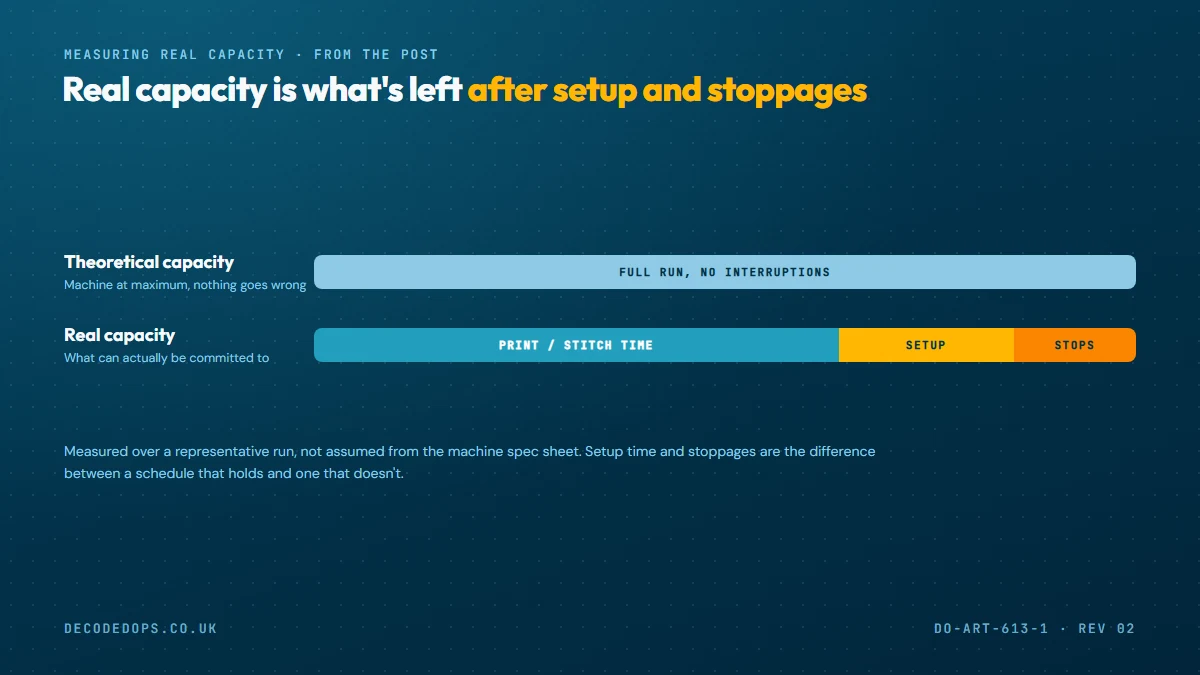
Theoretical capacity is the maximum output if everything runs perfectly. Real capacity is what you can actually commit to, accounting for the things that regularly don't run perfectly.
For embroidery, real throughput depends on average stitch count per job, number of heads, colour change frequency, and how often the machine stops for thread breaks, needle changes, or re-hooping. Running at theoretical maximum assumes none of those happen. That's not a safe assumption.
For screen printing, setup time per job is a real cost. A 30-job day with different designs is not 30 times the print time — it's 30 times the print time plus 30 times the setup time. Scheduling that doesn't account for setup time will always run late.
The practical approach is to measure actual throughput over a representative period — 4 weeks is usually enough — and build your capacity numbers from what actually happened, not what should theoretically be possible.
The Dependencies That Break Schedules
A job can only enter production when two things are true: the artwork is approved, and the stock is available. If either of those is outstanding, the job cannot start — regardless of where it sits in the schedule.
The dependency problem is that most schedules are built as if artwork approval and stock delivery are guaranteed. They're not. Artwork approval depends on customer behaviour. Stock delivery depends on your supplier. Neither of those is fully in your control.
The fix is building the schedule around confirmed dependencies, not assumed ones. A job isn't scheduled into production until artwork is signed off and stock is confirmed as available. It sits in a pre-production queue until both are confirmed, then slots into the production schedule at the appropriate point.
This means the delivery date quoted to a customer should be based on when both dependencies are likely to be cleared — not on when the job was ordered.
Building the Schedule
A production schedule for a decoration business needs to reflect three things:
- Total confirmed work in the queue. Every job that has cleared its dependencies (artwork signed off, stock confirmed) and is waiting for a production slot.
- Available capacity by day. Machine hours available, accounting for planned maintenance, staff availability, and the realistic throughput you've measured.
- Job sequencing logic. Which jobs go in which order — typically by delivery date, adjusted for setup efficiencies (batching similar substrates, same-colour runs).
Whether it lives in production scheduling software or on a wall board, the schedule should be visible to everyone involved in production — not held in one person's head or maintained in a spreadsheet only one person knows how to read. When the schedule is visible, people can flag problems before they become missed deliveries.
Batching and Sequencing for Efficiency
Production efficiency comes from minimising changeovers. For embroidery, this means batching jobs that use the same thread colours to avoid unnecessary colour changes. For screen printing, it means grouping jobs with the same ink colours or printing on the same substrate back to back.
This sounds obvious, but without a visual schedule that shows the full queue, batching decisions get made job-by-job rather than across the whole week's work. A scheduler who can see the full queue can sequence it for efficiency. Someone working through a list of individual jobs can't.
Rush Orders: The Policy Question
Rush orders happen in every decoration business. The question isn't whether to take them — it's whether you have a consistent answer for when you do and when you don't.
Without a policy, every rush order is a negotiation, and the loudest customer wins. Jobs that were promised to other customers get pushed back. The team is under pressure to do the impossible. The customers whose jobs moved get an experience they didn't expect.
A rush order policy answers:
- When is a rush order possible? Only when genuine capacity exists — i.e., another confirmed job can be moved without breaking a delivery commitment, or there's genuine spare capacity in the queue.
- What does a rush order cost? A premium is standard practice and reasonable. It compensates for the disruption and signals to the customer that this is an exception, not the default.
- What gets moved to accommodate it? If a rush order requires displacing another job, that's a decision for management, not for the production team to make in the moment.
A policy makes rush orders a manageable exception rather than a recurring chaos event.
Quality Under Pressure
Quality standards are the first thing that erodes when production is under pressure. The QC check gets skipped. The sign-off process gets abbreviated. The mistake that would have been caught at the pre-production stage goes through to finished goods.
Building quality checkpoints into the schedule — not as an optional step but as a time allocation — protects against this. If every job has a 15-minute QC slot allocated in the schedule, it happens. If QC is "whenever there's time," it doesn't happen when the schedule is under pressure.
Common Questions
How do you calculate production capacity?
Measure actual throughput over 4 weeks — what was actually produced per day, including setup time and stoppages. Use that number as your capacity baseline, not the theoretical maximum the machine is capable of under perfect conditions.
How do you handle rush orders without disrupting other jobs?
With a defined policy: rush orders are accepted when genuine capacity exists, carry a premium, and displacing another confirmed job requires a management decision. Without a policy, every rush order is a negotiation the loudest customer wins.
What causes production schedules to fail?
Schedules built on theoretical capacity, no mechanism for artwork and stock delays, and accepting every order without checking the impact on the existing queue. Fix those three and most schedule failures go away.

Plain English. No jargon. No vendor agenda.
A Clarity Audit maps your operations, finds the changes that will make the biggest difference, and gives you a plan you can act on. No reports you'll never read. No recommendations you can't implement.
See Clarity