The Real Cost of a Failed ERP Project
How much does a failed ERP implementation actually cost? More than the software. Here are the real numbers from a real project — and how an upfront audit would have prevented it.
The Project Nobody Talks About
As an ERP consultant, I've seen the same failure pattern repeat across 25 years in this sector. A business buys ERP software off the back of a confident demo, skips the requirements brief, and finds out eighteen months in that production has quietly reverted to spreadsheets and finance is running parallel manual processes because nobody trusts the data.
The licence was never the expensive part. The internal time spent propping up a system that doesn't fit the business is what actually drains the budget, and it keeps draining long after anyone official is still counting.
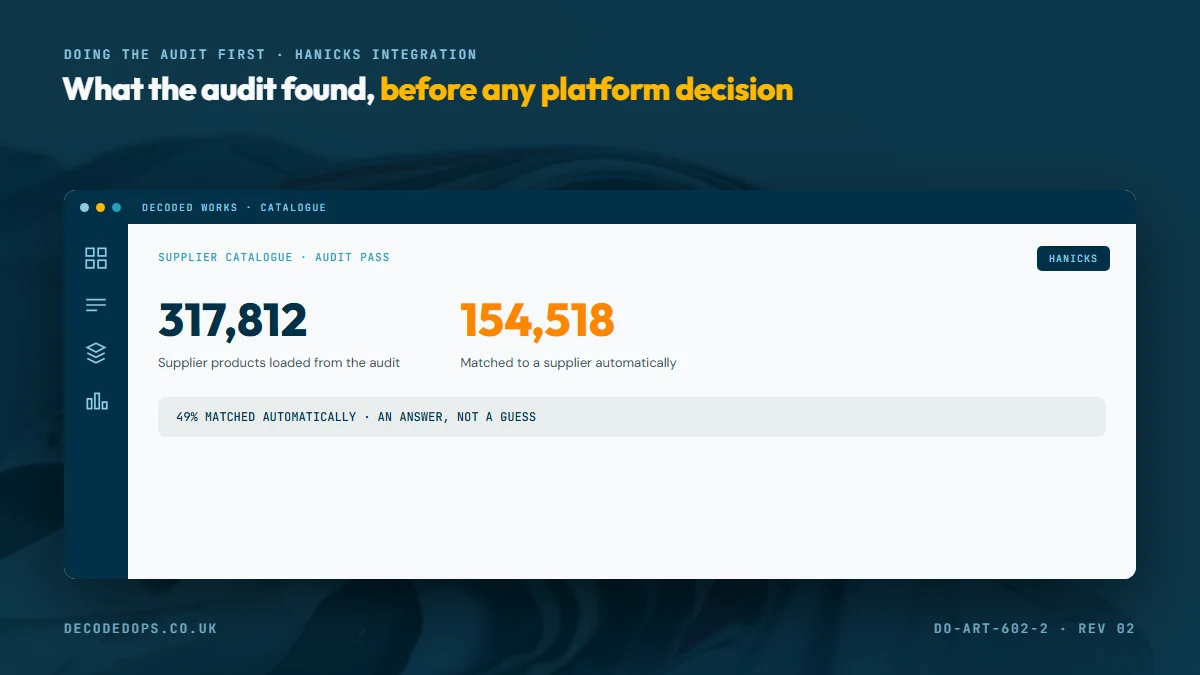
Compare that with what happens when the audit comes first. On the Hanicks integration, doing the data work before touching a platform meant 317,812 supplier products came in and 154,518 of them, 49%, matched to a supplier automatically.
That's the difference an upfront audit makes: not a guess about what might go wrong, an actual answer, before anyone signs a software contract.
Why ERP implementation failure is so common in this sector
ERP implementation failure in the print and embroidery sector follows a predictable pattern. The same five mistakes appear across almost every failed or struggling implementation. Manufacturing ERP software is not inherently unreliable — but it is almost always implemented without the right brief, the right oversight, or the right internal ownership.
The Real Cost Breakdown
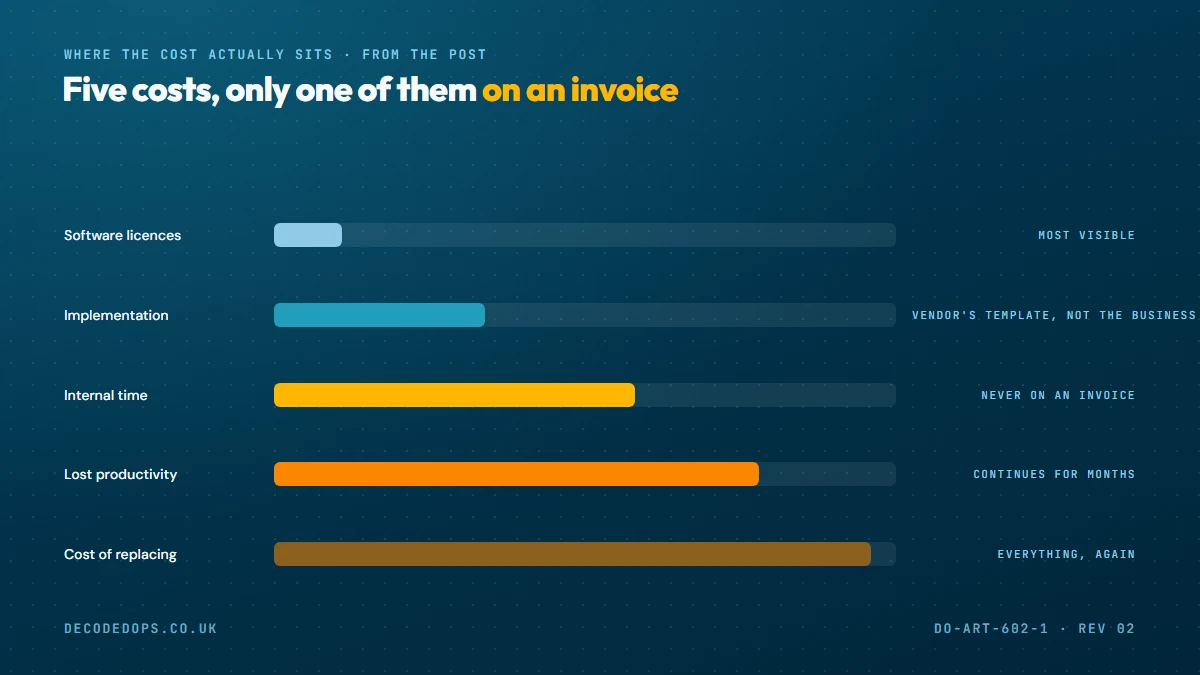
When an ERP project fails, the cost is rarely just the software licence. Here's what the full picture looks like:
Software Licences
The licences are usually the smallest cost. But they're the most visible, which is why they get the most attention. Most businesses focus on negotiating the licence fee down, while the real costs are accumulating elsewhere.
Implementation
Implementation fees cover configuration, data migration, training, and go-live support. The problem is that these are estimated based on the vendor's standard template — not your actual business. When the template doesn't fit, the costs escalate.
Internal Time
This is the cost that never gets measured. The project manager who spends 20 hours a week on the implementation instead of their day job. The production manager who attends requirement workshops. The finance team who have to run dual processes during transition. Across every failed implementation I've seen, internal time is where the real cost hides, the project manager, the production staff, the finance team running dual processes. It rarely shows up on an invoice, which is exactly why it gets missed in the initial business case.
Lost Productivity
During and after a failed implementation, productivity drops. Orders take longer to process. Errors increase. The team spend more time working around the system than working in it. This cost continues for months or years after the implementation is abandoned.
Cost of Replacing
If the implementation fails completely and you need to start over, you're looking at the entire cost again — software, implementation, and internal time, repeated from scratch — plus the damage to team confidence and the reluctance to invest in a second system after the first one failed.
The five patterns behind every ERP implementation failure
The print, embroidery, and decoration sector is not like manufacturing or distribution. Every order can be different. Personalisation data has to flow from order to production. Artwork approval is part of the workflow. Stock might be blank goods, finished goods, or held for specific customers.
Generic ERP systems are not designed for this. And even sector-specific systems need to be implemented correctly.
The most common failure pattern I see:
- No independent vendor brief. The business talks to vendors first, sees demos, and makes a decision based on presentation quality rather than fit.
- Implementation scoped by the vendor. The vendor scopes what their software does, not what the business needs. Gaps are discovered after go-live.
- No one accountable for outcomes. The project has a project manager, but nobody whose job depends on the system actually working for the business.
- Employee buy-in assumed, not earned. The team who will use the system every day were not meaningfully involved in the selection or design.
- Data quality ignored. The implementation proceeds on the assumption that existing data can be migrated as-is. It can't.
What independent ERP oversight would have prevented
In the case I described at the start, an operational audit would have identified:
- The ERP didn't handle decoration methods the way the production team worked
- The eCommerce integration gap couldn't be bridged by the chosen platform
- The data migration would require months of preparation, not weeks
- The implementation timeline was unrealistic given the business's seasonal peaks
- The training approach assumed digital literacy that didn't exist on the production floor
Every single one of these was identified after go-live — when fixing them cost ten times what it would have cost to address them before selection.
The 3x Clarity Guarantee
The Clarity Audit is priced to the scope of your business, and it comes with a guarantee: if the report doesn't identify at least three times the fee in recoverable cost or lost revenue, you get a full refund. No conditions. No questions.
Against the full cost of a failed implementation (licences, implementation fees, internal time and lost productivity, stacked together), that audit isn't insurance. It's near-certain cost avoidance.
Thinking about a new ERP?
Before you talk to vendors, talk to an ERP consultant who's seen this play out dozens of times. Our ERP implementation programme is built around exactly this — independent oversight, vendor accountability, and a clean exit if the project isn't tracking. Or start with why ERP projects fail in decorated goods businesses.
Plain English. No jargon. No vendor agenda.
A Clarity Audit maps your operations, finds the changes that will make the biggest difference, and gives you a plan you can act on. No reports you'll never read. No recommendations you can't implement.
See Clarity