What the Decoded Method Is — And Why Every Engagement Starts With It
Most consultants leave behind a report. The Decoded Method leaves behind a system the business actually runs. Here's what it is and why the order matters.
Most operations consultants leave behind a report. A document that describes what they found, what they recommend, and what the client should probably do at some point. Then they leave.
The business reads the report. Agrees with most of it. Files it. Carries on as before.
The Decoded Method exists because that pattern is not useful. Every engagement I run builds the same three things in the same order, and when I leave, the business runs them. Not because I'm still there. Because the system is.
What the Decoded Method is
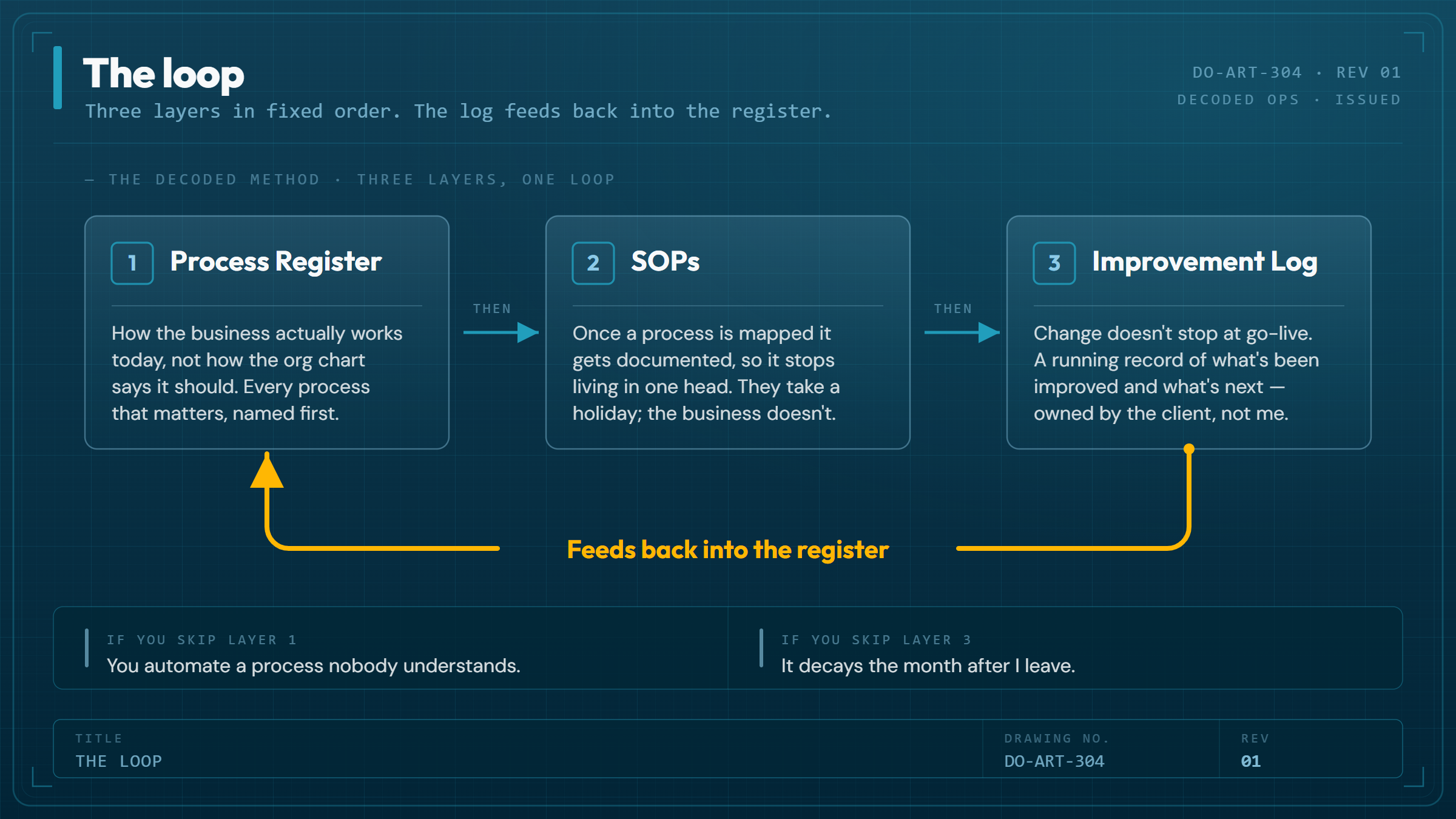
Three layers. One system. In this order.
Layer 1: The Process Register
A complete list of every process in the business. Not the detailed steps. Just what exists, who owns it, and how each process connects to the next.
Order intake connects to artwork approval. Artwork approval connects to production scheduling. Production scheduling connects to decoration, quality control, and despatch. The Process Register shows the whole picture on one page.
Most businesses in this sector do not have one. What they have instead is a group of people who collectively know how everything works. That is not the same thing. When one of those people leaves, or goes on holiday, or gets sick, the knowledge gaps become operational gaps. Sometimes quickly.
The Process Register makes the invisible visible. Until you know what processes you have, you cannot document them properly. Until they are documented, you cannot improve them reliably.
Layer 2: SOPs
Standard operating procedures for each process in the register. Specific enough that someone who does not normally do the job can follow them. Written in plain language for the person doing the work, not the person commissioning the document.
A working SOP answers three questions: who does this task, what do they need before they start, and what do they do, step by step including the exceptions. If it misses any of those, it will not be followed. Not because the team doesn't care, but because a document that doesn't match the reality of the job stops being useful the first time reality and document diverge.
SOPs do not make operations generic. Every decorated goods business has its own combination of machines, materials, supplier relationships, and customer expectations. Good SOPs reflect that specificity. They make the business less dependent on any one person without making it less like itself.
Layer 3: The Improvement Log
The loop that stops the system going out of date.
Every improvement identified gets logged. Every SOP updated. Every change recorded with a date and a reason. The system stays current rather than becoming a museum piece that everyone ignores because it no longer reflects how things actually work.
Without the Improvement Log, documentation has a shelf life of roughly six months. With it, the system compounds. Each improvement builds on the last. The business gets better over time, not just organised once.
Why the order matters
Document before you improve. Improve before you automate.
Almost every business that comes to me wanting to implement new software, AI tools, or automation is trying to skip to the third step. The appetite is understandable. The results, without the foundation, are consistent: faster versions of the problems they already had.
A business that automates an undocumented, inconsistent process gets faster chaos. A business that writes SOPs for processes it has not properly mapped ends up with documents that do not reflect how the work actually happens. The order is not bureaucracy. It is the shortest route to an operation that runs properly.
What clients get at each stage
The Decoded Method runs through every engagement, but how much of the system gets built depends on the programme.
After a Clarity Audit, the written assessment maps the current state for one priority area and shows where the Process Register would start. It is the first layer of the foundation.
A Deliver engagement builds the full Process Register across the business, writes SOPs for every priority process, and establishes the Improvement Log so the loop runs independently after the engagement ends. Six months of structured work. The system exists and runs when I leave.
A Transform or Retained Transformation programme goes further: all workstreams, staff training built in, and the Process & Quality System fully embedded across the operation. At this point, the business is also ready for the next stage: AI readiness assessment, automation where it makes sense, and tools that actually work because the foundation is there.
Where AI fits in
I am asked about AI in almost every engagement. The honest answer, for most businesses in this sector right now, is: not yet. Not because AI isn't useful, but because the foundation isn't there.
AI amplifies what already exists. If what exists is undocumented processes held together by specific people and fragmented data across disconnected systems, AI gives you faster, more expensive versions of those problems.
If what exists is a documented Process Register, working SOPs, and clean connected data, AI gives you meaningful improvements. Agents that can monitor the Improvement Log and flag recurring issues. Automation that handles the manual steps in a process because the process is written down clearly enough to automate. Tools that work because the data they need is structured and accessible.
The businesses that will get the most from AI in the next two to three years are the ones doing the boring work now. The Decoded Method is that boring work. It is also the reason the interesting work becomes possible.
The one-page version
There's a one-page summary of all this — the three layers, the order, and what gets built at each stage. It's the document I hand over at the start of most Clarity Audits.
No form, no email address. Download the playbook, or see what a Clarity Audit covers if you'd rather watch the method run against your own business.
Plain English. No jargon. No vendor agenda.
A Clarity Audit maps your operations, finds the changes that will make the biggest difference, and gives you a plan you can act on. No reports you'll never read. No recommendations you can't implement.
See Clarity