eCommerce Fulfilment for Decorated Goods: Why It's Harder Than a Normal Online Shop
A normal online order is pick, pack and ship. A decorated order has a production step in the middle, and most fulfilment software doesn't allow for it.
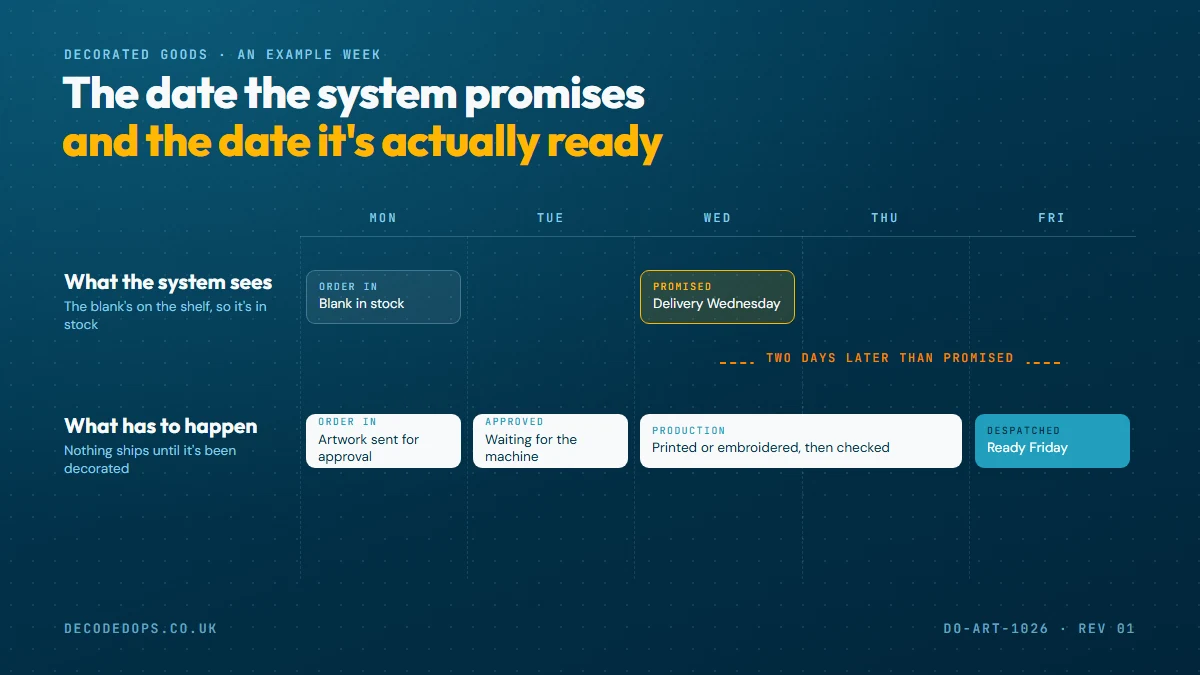
Most advice about eCommerce fulfilment is written for a normal online shop: the item's in stock, it gets picked, packed and shipped. I've run operations where that works fine. Print, embroidery and promo isn't one of them, because there's a whole production stage between the order coming in and it going out of the door, and hardly anything written about fulfilment allows for it.
The extra step nobody else has to plan for
A blank garment isn't what the customer's bought. They've bought the decorated garment, and that doesn't exist until the artwork's approved, there's space on a machine for it, and the printing or embroidery has actually been done. So the date you give the customer depends on how busy production is, as well as whether the blank's on the shelf. Most off-the-shelf systems only know whether something's in stock.
That's why so many decoration businesses end up giving out delivery dates they can't hit. The system sees the blank's there and promises a date that has nothing to do with when the job will actually be finished.
What it does to your stock numbers
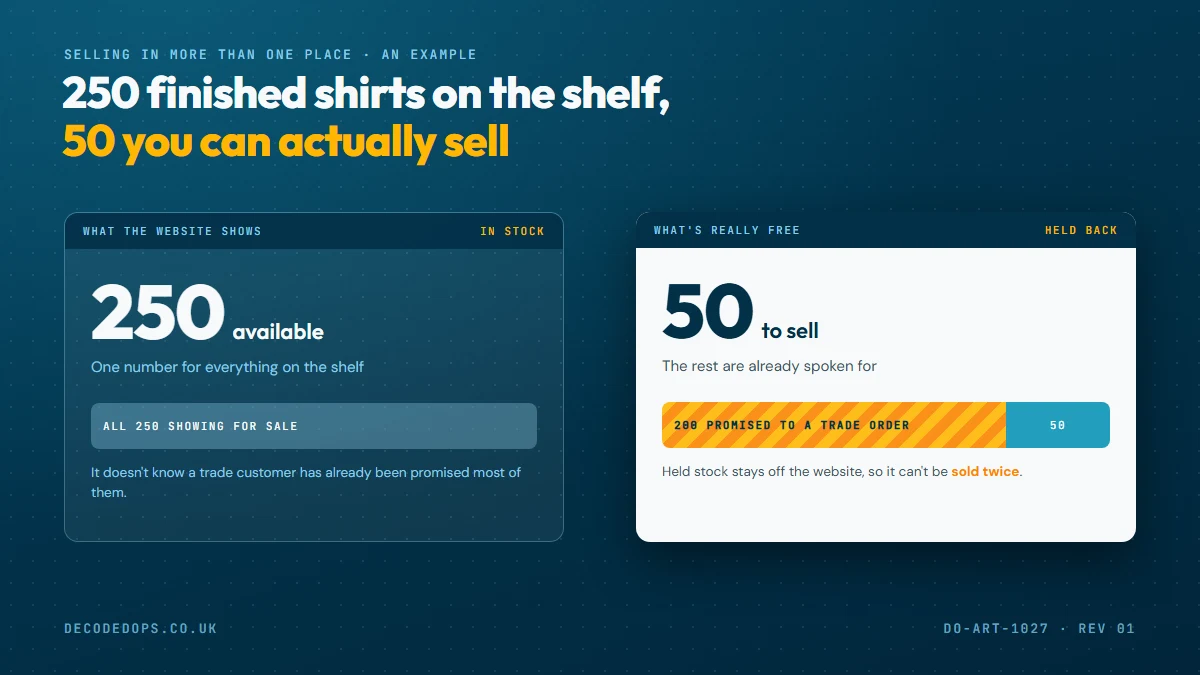
You've really got two lots of stock: the blanks, and the finished decorated items ready to go. A plain shirt on the shelf isn't available to someone who's ordered it with their logo on, whatever the screen says. Most stock systems add the two together into one number, which is technically right and no help at all to whoever's running the warehouse.
Where selling in more places makes it harder
Once you're selling in more than one place, say your own website, a marketplace and trade customers, it gets harder again. If your system doesn't know that 200 finished shirts are already promised to a trade order, your website will carry on selling them. A lot of cancelled orders and refunds in this trade start right there, and the fix is getting the system to keep track of what's already been promised.
What good fulfilment needs
None of this is complicated. It's the basics, set up for how decorated goods actually move:
- Production work that the same system giving out delivery dates can see, rather than it living on a whiteboard or a spreadsheet
- Blank and finished stock counted separately, with finished stock only showing as available once it's been through production
- Stock that's promised to one customer held back, so it can't be sold somewhere else
- Delivery dates worked out from how busy production is
Why it usually gets sorted too late
Most businesses only find the gap once they've grown into it. At low volume someone can keep the production queue in their head and check it before promising a date. The point where that stops working comes round quickly, and a business that was coping fine starts missing dates and selling stock it hasn't finished yet, right when the growth should be paying off.
I spent four and a half years running an agency building eCommerce for print and embroidery businesses, and what I found, customer after customer, is that most of what looked like a website problem was really an operations problem underneath. This is a good example. The website's doing its job. The system behind it just doesn't know how decorated stock works.
I've also been the one on the warehouse floor when it gets busy. At one business I ran operations for, we got to over 1,000 orders a day at peak, all personalised, with full barcode scanning and proper pick, pack and despatch behind it. None of that holds together unless the system knows the difference between a blank and a finished item, and at that volume you find out quickly, because the phone starts ringing with people asking where their order is.
Common questions
Can a standard eCommerce platform handle decorated goods fulfilment?
Not on its own. The mainstream platforms count stock one way, so they need linking up to your production side, with blanks and finished stock kept separate, before they'll work properly for decoration.
Should we build something or find software that already does it?
It depends on where you sell, how many orders you're doing and how many decoration methods you run. I can't answer that without seeing your setup, which is what a Clarity Audit is for.
What does getting it wrong actually cost?
The refunds and cancellations are the obvious bit. The bigger cost is the customer. Missing the delivery date on someone's first order is about the surest way I know to lose them.
So the thing to check this week is where your production queue actually lives, and whether whatever's giving out your delivery dates can see it. If it's in someone's head or on a spreadsheet, get in touch and I'll talk you through what a Clarity Audit would look at for your setup.
Plain English. No jargon. No vendor agenda.
A Clarity Audit maps your operations, finds the changes that will make the biggest difference, and gives you a plan you can act on. No reports you'll never read. No recommendations you can't implement.
See Clarity